Accelerating Feature Development with AI Agents: The Breakdown Approach That Transforms Software Delivery
Discover how AI agents can revolutionize software development by breaking down complex features into manageable, testable components, creating a more efficient and reliable development flow that delivers results faster.
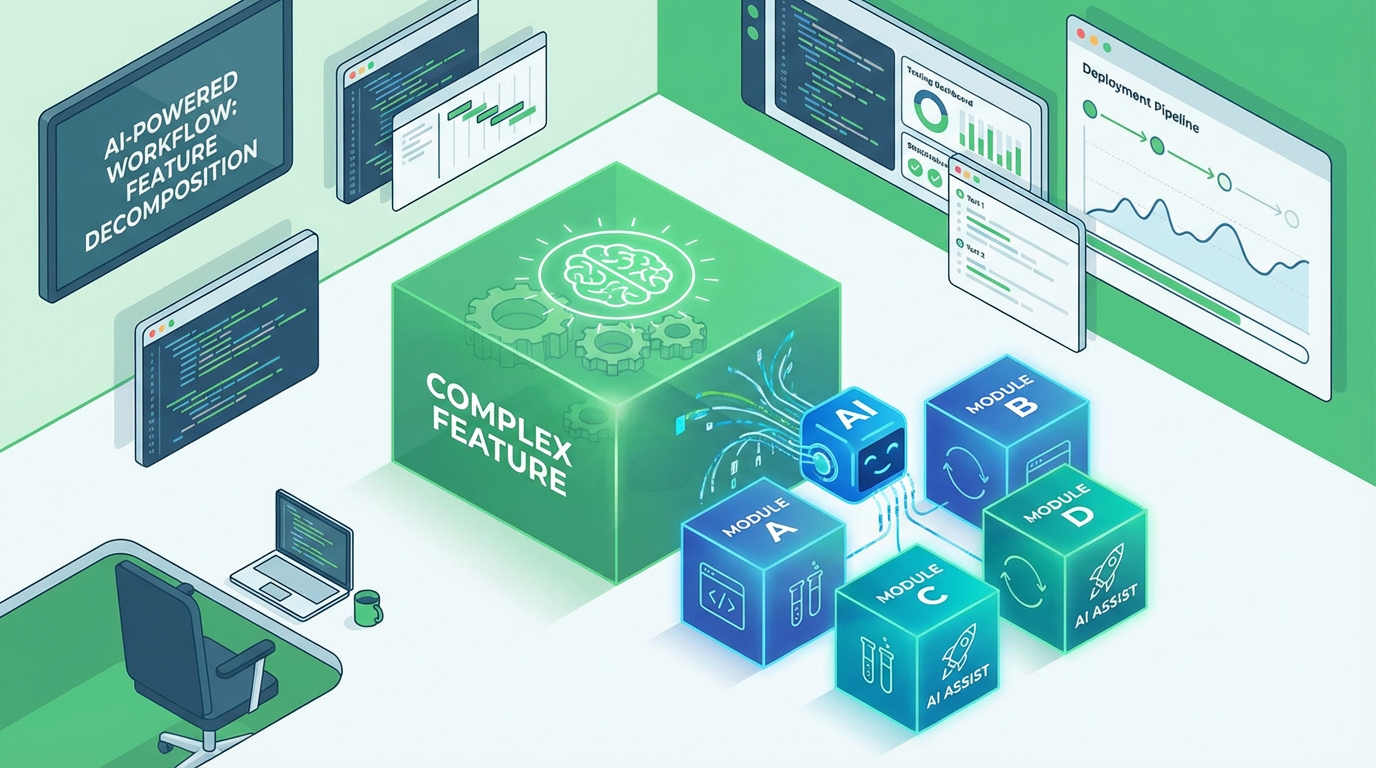
The Development Flow Revolution: From Monolithic Features to Iterative Excellence
Modern software development shouldn't be about building massive, complex features in isolation and hoping they work when deployed. Yet that's exactly what many teams still do—spending weeks or months on large features, only to discover integration issues, user experience problems, or performance bottlenecks at the very end.
The most successful development teams have discovered a different approach: Breaking down features into small, testable pieces that can be developed, validated, and deployed incrementally. This isn't just about agile methodology—it's about creating a development flow that naturally aligns with how AI agents work best.
When you combine this breakdown approach with AI-powered development tools, something remarkable happens: Complex features that once took months can be delivered in weeks, with higher quality and fewer bugs.
The Real Development Flow: Small Pieces, Big Results
The Traditional Problem
Most development teams approach new features like this:
- Requirements gathering (1-2 weeks)
- Architecture planning (1 week)
- Full feature development (4-8 weeks)
- Testing and bug fixes (2-4 weeks)
- Integration and deployment (1-2 weeks)
Total time: 9-17 weeks for a single feature, with high risk of failure and limited opportunities for course correction.
The AI-Enhanced Breakdown Approach
Smart development teams using AI agents work differently:
- Feature decomposition with AI analysis (1 day)
- Iterative development of small components (1-2 days each)
- Continuous testing and validation (ongoing)
- Incremental integration and feedback (weekly)
- Rapid deployment of working pieces (continuous)
Total time: 2-4 weeks for the same feature, with lower risk and continuous validation.
Case Study: The Speech-to-Text Enhancement
Consider a real-world example from field operations: Adding speech-to-text capability to a field visit application. This feature could transform how district managers document their store visits, but it seems complex and time-consuming.
Traditional Approach Estimation
- UI/UX design: 2 weeks
- Speech recognition integration: 3 weeks
- Form population logic: 2 weeks
- Error handling and validation: 2 weeks
- Testing and refinement: 3 weeks
- Total: 12 weeks
AI-Enhanced Breakdown Approach
Day 1: Feature Analysis and Decomposition AI agent analyzes the requirement and suggests breakdown:
- Basic speech capture functionality
- Simple transcription display
- Form field mapping
- Auto-population logic
- Error handling and user feedback
- Performance optimization
Week 1: Core Speech Capture (2 days)
- Implement basic microphone access
- Add start/stop recording controls
- Display recording status to user
- Result: Users can record audio (testable immediately)
Week 1: Basic Transcription (2 days)
- Integrate speech-to-text API
- Display transcribed text in real-time
- Handle basic error cases
- Result: Users can see their speech converted to text
Week 2: Smart Form Mapping (3 days)
- Analyze form structure with AI
- Create mapping rules for common phrases
- Implement basic auto-population
- Result: Speech automatically fills relevant form fields
Week 2: Enhancement and Polish (2 days)
- Add confirmation dialogs
- Improve error messaging
- Optimize for mobile performance
- Result: Production-ready feature
Total Implementation Time: 9 days (less than 2 weeks)
The AI agent's assessment was accurate: "It will take one prompt and 2 minutes to add it" to the existing workflow once the foundation is in place.
Why the Breakdown Approach Works So Well with AI
1. AI Excels at Small, Focused Tasks
AI agents perform best when given specific, well-defined problems to solve:
- Code generation for individual functions
- API integration for specific services
- Error handling for particular scenarios
- Testing of isolated components
When you break features into small pieces, each piece becomes an ideal task for AI assistance.
2. Immediate Feedback and Validation
Small components can be tested immediately:
- Functionality verification happens in minutes, not weeks
- User feedback can be gathered on working prototypes
- Performance issues are identified early
- Integration problems are caught before they compound
3. Reduced Cognitive Load
Developers can focus on one small problem at a time:
- Less context switching between different aspects of the feature
- Clearer problem definition makes AI assistance more effective
- Faster debugging when issues are isolated to small components
- Better code quality through focused attention
Implementation Framework: The AI-Enhanced Development Process
Phase 1: Intelligent Feature Decomposition
AI-Assisted Analysis:
Prompt: "Break down this feature request into small, testable components that can be developed incrementally: [feature description]"

AI Response:
1. Core functionality (minimal viable feature)
2. User interface components
3. Data processing logic
4. Integration points
5. Error handling
6. Performance optimizations
7. Advanced features
Prioritization Matrix:
- High Impact, Low Effort: Implement first
- High Impact, High Effort: Break down further
- Low Impact, Low Effort: Consider for later phases
- Low Impact, High Effort: Question necessity
Phase 2: Rapid Prototyping with AI
Component Development Cycle:
- AI generates initial code based on component specification
- Developer reviews and refines the generated code
- Immediate testing of the isolated component
- Quick iteration based on test results
- Integration with existing components
Example Development Session:
Developer: "Create a React component that captures audio from microphone"
AI: [Generates component with proper error handling]
Developer: Tests component → Works but needs better UX
Developer: "Add visual feedback for recording state"
AI: [Updates component with recording indicators]
Developer: Tests again → Perfect, ready for integration
Phase 3: Continuous Integration and Validation
Daily Integration Cycle:
- Morning: Review previous day's components
- Midday: Integrate new components with existing system
- Afternoon: Test integrated functionality
- Evening: Plan next day's components based on results
Validation Checkpoints:
- Does the component work in isolation?
- Does it integrate cleanly with existing code?
- Does it meet the user's actual needs?
- Are there any performance implications?
Real-World Benefits: Measuring the Impact
Development Speed Improvements
Teams using AI-enhanced breakdown approaches report:
- 60% faster feature delivery times
- 40% fewer critical bugs in production
- 75% reduction in feature scope creep
- 50% less time spent on debugging
Quality Improvements
Better Testing Coverage:
- Each small component is thoroughly tested
- Integration issues are caught early
- User feedback is incorporated continuously
- Performance problems are identified quickly
Cleaner Code Architecture:
- Smaller functions are easier to understand
- Better separation of concerns
- More reusable components
- Easier maintenance and updates
Team Satisfaction Benefits
Reduced Developer Stress:
- Clear, achievable daily goals
- Immediate sense of progress
- Less overwhelming complexity
- More opportunities for success
Enhanced Collaboration:
- Easier code reviews on small components
- Better knowledge sharing across team
- More opportunities for pair programming
- Clearer communication about progress
Advanced Techniques: Maximizing AI Assistance
1. Context-Aware Code Generation
Technique: Provide AI with comprehensive context about your codebase
"Given our existing React architecture using TypeScript and our custom hooks pattern, create a component that..."
Result: AI generates code that fits seamlessly into your existing patterns
2. Test-Driven Development with AI
Technique: Have AI generate tests first, then implementation
"Create comprehensive tests for a speech-to-text component that handles errors gracefully"
[AI generates test suite]
"Now create the component that passes these tests"
[AI generates implementation]
Result: Higher test coverage and more robust error handling
3. Progressive Enhancement
Technique: Start with minimal functionality and enhance incrementally
Day 1: Basic recording functionality
Day 2: Add transcription
Day 3: Add form integration
Day 4: Add error handling
Day 5: Add performance optimization
Result: Always have a working version, with continuous improvement
Common Pitfalls and How to Avoid Them
Pitfall 1: Components Too Small
Problem: Breaking features into pieces so small they lose coherence Solution: Ensure each component delivers user value, even if minimal
Pitfall 2: Ignoring Integration Complexity
Problem: Focusing only on individual components without considering how they work together Solution: Plan integration points early and test them frequently
Pitfall 3: Over-Relying on AI
Problem: Accepting AI-generated code without understanding or reviewing it Solution: Always review, test, and understand AI-generated code before integration
Pitfall 4: Skipping User Feedback
Problem: Building components without validating they meet user needs Solution: Get user feedback on working prototypes as early as possible
The Strategic Advantage: Why This Approach Wins
Market Responsiveness
Teams using breakdown approaches can:
- Respond faster to changing requirements
- Pivot quickly when user feedback indicates different needs
- Deliver value incrementally rather than waiting for complete features
- Reduce risk of building the wrong thing
Competitive Edge
Organizations that master this approach gain:
- Faster time-to-market for new features
- Higher quality software with fewer bugs
- Better user satisfaction through continuous feedback incorporation
- More efficient development teams with higher job satisfaction
Technical Debt Reduction
The breakdown approach naturally reduces technical debt:
- Smaller components are easier to refactor
- Continuous integration prevents accumulation of problems
- Regular testing catches issues before they compound
- Incremental improvements keep the codebase healthy
Call to Action: Transform Your Development Process Today
The tools exist. The methodology is proven. The competitive advantage is real.
Your 30-Day Development Transformation:
Week 1: Assessment and Training
- Audit current feature development processes
- Identify bottlenecks and pain points
- Train team on breakdown methodology
- Set up AI development tools and workflows
Week 2: Pilot Implementation
- Choose a medium-complexity feature for pilot
- Break it down using AI-assisted analysis
- Implement first components using AI assistance
- Establish daily integration and testing routines
Week 3: Refinement and Optimization
- Gather feedback on pilot process
- Refine breakdown and development techniques
- Optimize AI prompts and workflows
- Document best practices and lessons learned
Week 4: Scaling and Standardization
- Apply methodology to additional features
- Train additional team members
- Establish organization-wide standards
- Plan for continuous improvement
The Development Reality
Your competitors are already exploring AI-enhanced development workflows. The question isn't whether this approach will become standard—it's whether you'll adopt it before they do.
Start today:
- Choose one feature currently in development
- Break it down into small, testable components
- Use AI assistance to accelerate component development
- Test and integrate components daily
- Measure the impact on delivery speed and quality
Software development doesn't have to be about choosing between speed and quality. With AI-enhanced breakdown approaches, you can have both—and gain a significant competitive advantage in the process.
Ready to revolutionize your development process with AI-enhanced workflows? Our AI Agents Workshop shows you exactly how to implement breakdown methodologies that accelerate feature delivery while improving code quality. Learn to build development processes that leverage AI effectively while maintaining human oversight and creativity.
Related Articles
AI for Instant Market Intelligence: The Competitive Analysis Revolution
Discover how AI agents can deliver comprehensive competitive analysis in minutes instead of weeks, transforming market intelligence from a quarterly event into a real-time strategic capability.
Automating Training and Onboarding: How AI Can Instantly Generate Step-by-Step Recaps
Discover how AI agents can solve the common problem of lost knowledge and inconsistent training materials by automatically generating comprehensive step-by-step guides from live sessions.
The Two Pillars of AI Agent Evaluation: Mastering Retrieval and Generation for Reliable RAG Systems
Discover the essential framework for evaluating RAG (Retrieval-Augmented Generation) agents through two critical pillars: retrieval accuracy and generation quality. Learn how to build reliable AI systems that deliver consistent, trustworthy results.